

How to Save Money as a Single Mum in the UK: 15 Ways That Actually Work
I used to think saving money meant being disciplined. Sitting down every Sunday with a spreadsheet, saying no to everything, feeling faintly guilty every time I bought a coffee. It doesn’t work like that, not really, and definitely not when you’re doing this on one income with a small person who needs new shoes every four months.
That’s the real question this post answers: how do you save money as a single mum UK without the guilt or the spreadsheet?
What actually changed things for me wasn’t discipline. It was noticing where the money was quietly leaking out and fixing those leaks one at a time instead of trying to overhaul everything at once.
Some of those leaks were benefits I wasn’t claiming. Some were subscriptions I’d forgotten I had. One was a mobile contract I’d been on for three years that cost more than double what a new customer would pay for the exact same thing.
In this post, you’ll learn:
- How to check you’re claiming everything you’re entitled to before you touch your spending
- Which bills to tackle first, and where the loyalty penalty is quietly costing you money
- How to use cashback and reselling as a proper system rather than an occasional afterthought
- How to build a savings habit that survives a bad month, including one guaranteed 50% return most people miss
Start with what you’re entitled to, not what you can cut
Before you touch your spending, check you’re getting everything you’re owed. This sounds obvious.
But benefits charities regularly find that people are missing out on hundreds of pounds a month simply because they didn’t know a particular support was available, or assumed they wouldn’t qualify.
So…
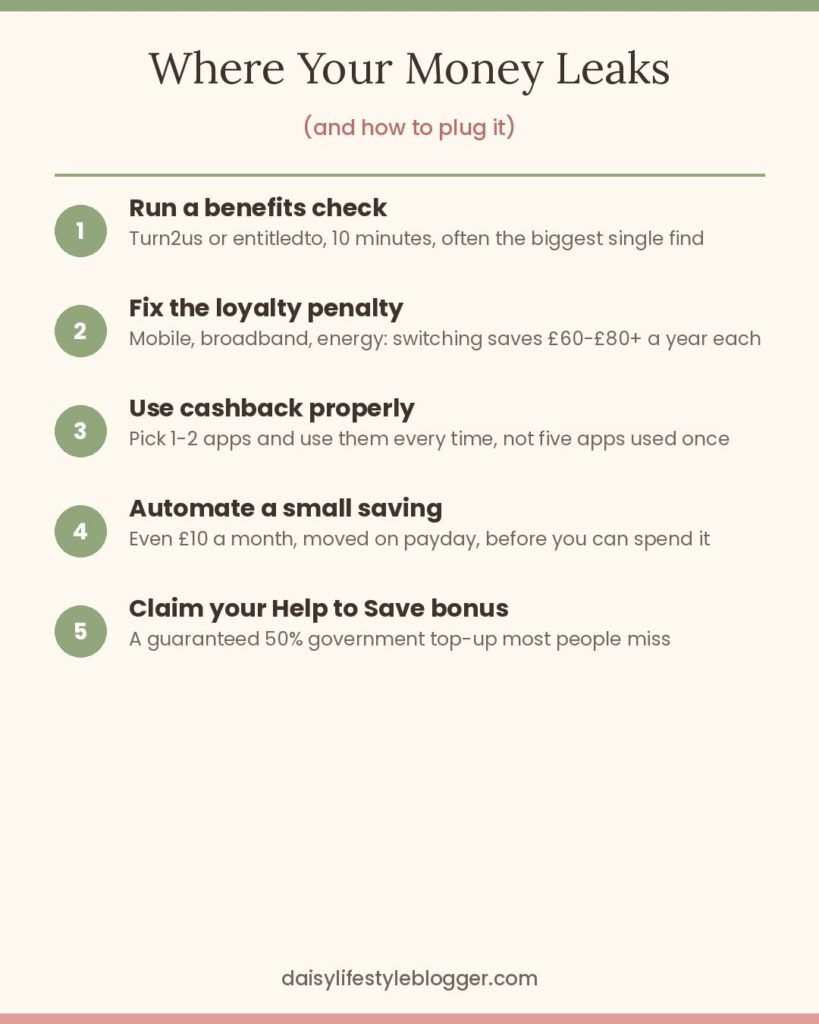
- Run a proper benefits check. Use a free calculator like Turn2us or entitledto rather than guessing. These take ten minutes and cover Universal Credit, Council Tax Reduction, and other support you might not have applied for.
- Look at Council Tax Reduction (sometimes called Council Tax Support). This is separate from Universal Credit and is means-tested by your local council, so the amount varies depending on where you live. If you’re a single adult in the household, you’re also entitled to the 25% single person discount on top of any reduction, and a lot of people never apply for it because they assume their existing benefits already cover it.
- Check your child maintenance is set up properly. If your child’s other parent isn’t paying anything, or you’ve never formalised an arrangement, the Child Maintenance Service calculates payments based on the paying parent’s income: 12% of their gross weekly income for one child, 16% for two, and 19% for three or more, when their income falls in the standard band. It costs nothing to apply, and even a modest, reliable monthly amount makes a real difference over a year.
Cut your biggest bills first
Small savings matter, but your biggest three costs, housing, energy, and childcare, are where the real money is. We covered childcare support in detail in The Single Mum Budget UK Guide, including Tax-Free Childcare and the 30 hours scheme, so I won’t repeat all of that here. But energy, mobile contracts, and housing are worth their own look.
- Check whether you’re on a supplier’s standard variable tariff. Ofgem’s price cap changes every three months, and it only limits what you pay per unit, not your total bill. If you’re not on a fixed tariff, it’s worth comparing prices every time the cap changes using a comparison tool or MoneySavingExpert’s cheap energy guide, since fixed deals sometimes beat the capped rate.
- Switch to Direct Debit if you’re not already on it. Paying by standard credit (getting a bill and paying it) is typically the most expensive way to pay for energy. Moving to Direct Debit can shave a noticeable amount off your annual bill for exactly the same energy use.
- Ask about the Warm Home Discount. This is a one-off £150 payment applied to your electricity bill each winter for households on qualifying means-tested benefits. It’s usually automatic if you’re eligible, but it’s worth confirming with your supplier that your details are correctly registered, especially if you’ve moved house or changed your name on the account recently.
- Check your mobile and broadband contract for the loyalty penalty. Providers routinely charge existing customers more than new ones for the same package, on the assumption that most people won’t get round to switching or haggling. Ofcom’s own research puts the average saving from switching at £61 to £83 a year, though Citizens Advice has documented long-term customers paying considerably more, in some cases thousands of pounds over a decade or more. A five-minute call to ask for a better deal, or an hour spent comparing providers once your contract ends, is worth doing.
- Look at your rent or mortgage honestly once a year. I know this one is uncomfortable. But if a smaller two-bedroom flat costs meaningfully less than where you are now, in council tax, in energy, in space you’re paying to heat and don’t use, it’s worth doing the sums at least once. It doesn’t mean you have to move. It just means you’re making an informed choice rather than an assumed one.

Use cashback and reselling properly, not half-heartedly
Cashback apps and reselling only work if you treat them as a system, not an occasional afterthought.
- Pick two cashback apps and stick to them. TopCashback and Quidco both work on the same principle: you shop through their link, and a percentage of what you spend comes back to you. The trick is picking one or two and actually using them every time you shop online, rather than downloading five and using none consistently.
- Use loyalty schemes at the supermarket you already shop at. Tesco Clubcard and the Nectar card at Sainsbury’s both offer meaningfully lower prices on hundreds of items if you scan the card, on top of the points you build up. If you’re doing a weekly shop anyway, this is money you’re leaving on the table by not signing up. I cover the food shop in much more depth, including how I feed us for less without living off value beans, in Single Mum Grocery & Food Budget UK.
- Sell what you’re not using, properly. Not just once in a big clear-out, but as a habit. Vinted works well for children’s clothes and shoes, which get outgrown faster than they get worn out. Facebook Marketplace tends to work better for larger items like furniture, prams, and toys. A ten-minute habit of listing outgrown items each month adds up to real money over a year, and it clears space at the same time. I go into more ways to turn spare time into extra income in How to Make Money as a Single Mum UK, if you want to take this further.
- Check unclaimed money before assuming there isn’t any. If your children were born between September 2002 and January 2011, they may have a Child Trust Fund sitting unclaimed. Thousands of these matured accounts, averaging over £2,000 each, have never been claimed. It takes ten minutes to check using the gov.uk Child Trust Fund locator.
Build a savings habit that survives a bad month
The advice to save 20% of your income doesn’t mean much when you’re working out whether you can afford the bus fare this week. What actually works is smaller and more forgiving.
- Automate a small, boring amount. Even £10 or £20 a month, moved automatically the day you’re paid, into an account you don’t touch, builds up without you having to think about it or feel guilty when you can’t do more some months.
- Use a separate account for savings, even a free one. Keeping savings in the same account as your everyday spending means it disappears into general use. A separate easy-access savings account, even one paying very little interest, creates enough distance that you think twice before dipping in.
- Try a round-up app if your bank offers one. Several UK banking apps round up your card purchases to the nearest pound and save the difference automatically. It’s not going to fund an emergency fund on its own, but it’s money you genuinely wouldn’t have noticed otherwise.
- Save windfalls before you get used to having them. Tax refunds, Child Benefit backdated payments, or a one-off gift all tend to disappear into everyday spending without you noticing, simply because they weren’t part of your usual budget. Moving even half of an unexpected amount straight into savings the day it lands means it’s gone before it becomes part of your normal spending pattern.
- If you’re on Universal Credit, look at Help to Save. If you have some earned income each month, this scheme gives you a 50% government bonus on what you save, up to certain limits, paid out after two and four years. It’s one of the few savings products where the return is guaranteed rather than dependent on interest rates.
A few honest notes on what doesn’t work
Not everything marketed at single parents actually saves money. A few things worth being sceptical of:
Extreme couponing takes hours for a return that’s often smaller than the value of your time. Cutting every subscription rather than reviewing them properly can mean losing something that genuinely helps, a meal kit that stops food waste, for instance, for a saving that doesn’t match the disruption.
And switching everything constantly, energy, broadband, insurance, every few months, can cost more in admin time and cancellation friction than it saves, compared to switching once a year properly.
The goal isn’t to do everything on this list. It’s to pick the three or four that fit your actual life and do them consistently.
Daisy’s Take 💛
The money leak that shocked me most wasn’t something dramatic. It was my mobile contract. I’d been on the same plan for nearly three years — same network, same number — and when I finally called to cancel and move elsewhere, they immediately offered me a better deal than any new customer was getting. Three years of overpaying, just because I never picked up the phone.
Final thought
None of this is about becoming a different kind of person overnight.
It’s about finding the two or three things from this list that actually fit your week, and doing them consistently rather than trying to do all of it at once and giving up by February.
Start with the benefits check. That one’s free, takes ten minutes, and for a lot of readers it uncovers more than anything else on this list.
What’s the one thing from this guide you’re going to try first?
Frequently asked questions
What’s the quickest way to save money as a single mum in the UK?
Run a benefits check first. It takes ten minutes and often uncovers more money than weeks of careful budgeting, because it’s money you’re already entitled to rather than money you have to find by cutting back.
Is child maintenance worth applying for if my ex isn’t reliable?
Yes, even an imperfect arrangement is usually better than none. The Child Maintenance Service can also take enforcement action, including deductions directly from wages, if payments stop.
Do cashback apps actually make a difference?
Used consistently on things you were already going to buy, yes, the amounts add up meaningfully over a year. Used occasionally and abandoned, not really. Consistency is what makes the difference, not which app you pick.
Should I switch energy supplier or stay on the price cap?
It depends on the market at the time. Since the price cap changes every three months, it’s worth checking a comparison site whenever it updates, rather than assuming the capped rate is always the cheapest option available.
I’ve claimed everything I know about. What am I missing?
Ask a local welfare rights adviser or Citizens Advice to do a full benefits check with you once a year, even if you think you know your entitlements. Rules change, your circumstances change, and advisers see cases like yours every day, so they often spot things a general online calculator misses.